
What is dependency management: A guide for project managers
What is dependency management: A guide for project managers
Fifty1 Consulting ·

TL;DR:
- Dependency management is often overlooked by leaders, yet it is crucial for preventing security issues and delivery failures caused by external software components. Effective strategies include version pinning, lock files, vendoring, and private registries, which build software stability and control. Leadership must integrate dependency policies into project planning, risk management, and infrastructure reviews to mitigate dependency risks proactively and ensure delivery success.
Most project managers think dependency management is purely a developer concern, something the engineering team handles quietly in the background while leadership focuses on timelines and budgets. That’s a costly misunderstanding. What is dependency management, really? It’s the practice of identifying, controlling, and maintaining the external software components your applications rely on to function. Get it wrong and you’re looking at broken builds, security breaches, and delivery failures that no status report can explain away. This guide breaks down the core concepts, practical strategies, and real delivery implications you need to know.
What is dependency management and why it matters for delivery leaders
Let’s start with the basics. A software dependency is a piece of software your application requires to function, such as a library or plugin. Your application doesn’t live in isolation. It borrows functionality from dozens or even hundreds of external packages, and those packages borrow from others.
There are two primary types you need to know:
- Direct dependencies: Components your application references explicitly in its configuration.
- Transitive dependencies: Components that your direct dependencies rely on, forming a layered dependency tree you may never directly see but absolutely own the risk for.
That second type is where things get sneaky. You think you’re managing ten dependencies. In reality, you’re responsible for the security and stability of potentially hundreds.
Understanding dependency management also goes beyond code. It encompasses the policies, processes, and tooling your team uses to control what external software enters your codebase, when it gets updated, and who approves changes. Think of it like vendor management for your software supply chain. You wouldn’t let a contractor use unapproved materials on a construction site. Why let unvetted code packages run in your production system?
For delivery leaders, this has direct project implications. When a dependency breaks or a security vulnerability surfaces, it doesn’t just affect developers. It delays sprint cycles, triggers emergency patches, and can derail scheduled releases. If you’re managing tech projects successfully, dependency risk belongs in your planning conversations.
Core methods and best practices in dependency management
Now that we understand what dependency management covers, let’s look at the core practical strategies your teams should be using and what you should be asking about in planning sessions.
-
Version pinning. Version pinning means restricting an application dependency to a specific version or version range, ideally a single version. This keeps builds predictable and reproducible. The tradeoff? You have to actively monitor pinned versions for security patches and updates. Ignore it and your “stable” setup quietly becomes a liability.
-
Lock files. A lock file records the exact version of every dependency and transitive dependency at a given point in time. Tools like npm and Yarn generate these automatically. Lock files are your best friend for onboarding new team members and ensuring every environment runs identical code. Without them, “it works on my machine” becomes a recurring incident report.
-
Vendoring. This means copying your dependencies directly into your source code repository. You gain maximum control and can work offline, but it increases repo size and creates a maintenance burden. It’s a valid approach when external registries aren’t trusted or available, but it’s not a set-it-and-forget-it solution.
-
Private registries. When possible, use a private registry for your dependencies. When you can’t, consider vendoring to maintain control over your software supply chain. Private registries act as a gated checkpoint, only approved, scanned packages make it through.
Pro Tip: Ask your engineering team in your next sprint planning session: “Do we have a lock file committed to version control, and when did we last audit our pinned versions?” Their answer will tell you a lot about your project’s current dependency risk posture.
These four approaches form the backbone of any solid dependency management strategy. The right mix depends on your project’s scale, security requirements, and team maturity. Weaving this awareness into your project lifecycle management process ensures dependency decisions get made deliberately, not reactively.
Advanced dependency management for infrastructure as code projects
Beyond software libraries, dependency management poses unique challenges in infrastructure-as-code (IaC) projects. If your team runs infrastructure with Terraform, this section is relevant to your delivery risks.

In Terraform, resources often depend on other resources to exist before they can be created. Declare these relationships wrong and your infrastructure builds fail, or worse, build in the wrong order with unpredictable results.
There are two ways to establish these dependencies:
- Implicit dependencies come from expression references between resources, meaning Terraform reads the relationship from your configuration automatically. These are preferred because they’re precise and self-documenting.
- Explicit dependencies use the "depends_on` meta-argument to force Terraform to complete upstream actions before creating a dependent object.
The instinct for many teams is to use depends_on everywhere because it feels safe. But overusing depends_on reduces clarity and precision. Reserve it for situations where hidden or behavior-level dependencies exist that Terraform can’t infer on its own.
As a delivery leader, you don’t need to write Terraform yourself. But you do need to know that poorly declared infrastructure dependencies are a legitimate source of failed deployments and production incidents. This is worth a direct conversation with your platform or DevOps team.
Pro Tip: Include an infrastructure dependency review as part of your pre-deployment checklist. Ask: “Are there any undeclared dependencies in our IaC that could cause ordering failures?” One hour of review can prevent a multi-hour production rollback.
Stay on top of these risks with structured project monitoring techniques baked into your delivery cadence.
Security implications and policies in dependency management
Understanding the technical details is critical, but equally important is recognizing how dependency management shapes your project’s security exposure. This is where many delivery leaders have the biggest blind spots.
Lack of dependency management increases the risk of vulnerabilities from external software packages used during development, builds, or deployment. The 2021 Log4Shell vulnerability is the textbook example. A widely used Java library had a critical flaw, and organizations that lacked dependency visibility scrambled to find where they were even using it. Companies with good dependency management identified and patched exposure in hours. Others spent weeks.
Your dependency management policy should address:
- ✅ Access controls for who can add or update dependencies
- ✅ Approval workflows for new or major version changes
- ✅ Automated vulnerability scanning integrated into CI/CD pipelines
- ✅ Regular audits of your full dependency tree, not just direct dependencies
- ✅ Incident response procedures when a critical vulnerability surfaces in a dependency
On the tooling side, centralizing your dependencies through an artifact registry is a practical step with real security payoff. Artifact Registry centralizes artifacts and dependencies, improving visibility and control, and includes security features like vulnerability scanning and access control.
The uncomfortable truth: Most project teams know they should be auditing their dependencies. Almost none do it consistently. A quarterly dependency audit is less glamorous than a sprint demo, but it’s the kind of foundational project management practice that keeps you out of emergency war rooms.
Applying dependency management to improve project execution and delivery outcomes
With a firm grasp of dependency concepts, techniques, and risks, let’s look at how you translate this into better delivery outcomes. Because theory without application is just trivia.
Traditional vs. best-practice dependency management
| Area | Ad hoc approach | Best-practice approach |
|---|---|---|
| Version control | Dependencies updated casually | All versions pinned and locked |
| Security | Reactive (patch after breach) | Proactive scanning and audits |
| Build reliability | “Works most of the time” | Fully reproducible builds every time |
| Visibility | Only developers know what’s used | Full dependency inventory documented |
| Risk management | Dependencies not in risk register | Dependency risks tracked and owned |
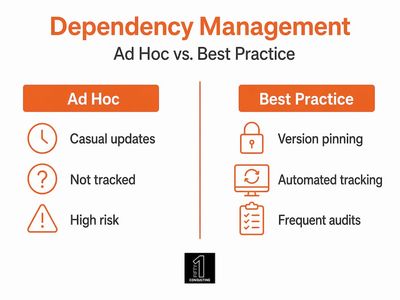
Effective dependency management impacts security, build reliability, and delivery success. That row in the table above about risk management is the most important one for you as a delivery leader.
How to integrate dependency management into your delivery process
-
Add dependency review to your project kickoff. Before a single line of code is written, establish who owns dependency decisions, what the approval process looks like, and what tools will be used.
-
Include dependency risks in your risk register. Treat unpatched or unvetted dependencies as a tracked risk item with likelihood, impact, and owner assigned.
-
Gate releases on dependency health. Make vulnerability scanning a required step before any production deployment. If critical vulnerabilities exist, the release is blocked until they’re resolved.
-
Set up automated alerts. Tools like Dependabot, Snyk, or your artifact registry can flag new vulnerabilities in your dependency tree automatically. These alerts should reach your technical leads, not sit in a developer’s inbox.
-
Review dependency status in retrospectives. When a build fails or a security issue surfaces, include a dependency audit in your post-mortem. Connect it back to managing project scope and delivery outcomes.
Dependency management isn’t a one-time setup. It’s a continuous discipline that should be woven into your team’s operating rhythm.
Why dependency management deserves more attention in your project leadership
Here’s a perspective most articles skip: the reason dependency management stays buried in technical backlogs isn’t that it’s too complicated for project leaders. It’s that no one has made the organizational case for ownership.
Engineers think it’s handled. Project managers assume it’s engineering’s problem. Leadership only hears about it when something breaks. That gap in ownership is exactly where delivery failures are born.
Think of dependency management like the plumbing in a building. Nobody notices it when it works. The moment it fails, everything stops. The difference between a good building manager and a reactive one is whether plumbing is on their maintenance calendar before the burst pipe.
The conventional wisdom is to trust your tech team to handle dependencies and stay in your lane as a PM. That’s the wrong instinct. Your job is to reduce delivery risk, and unmanaged dependencies are a delivery risk. They belong on your radar.
The most effective delivery leaders we see treat dependency management as part of their strategic program management approach. They ask the right questions, establish clear ownership, and ensure their teams have both the tools and the policy to manage external software responsibly.
You don’t need to read every package.json file. You do need to know whether your project has a process, who owns it, and when it was last checked. That’s leadership.
Explore DazIQ, sharpen your decision-making on dependencies and project delivery
Reading about dependency management is one thing. Knowing how to act when a critical vulnerability drops two days before a release? That takes practice.

DazIQ is an AI-powered career simulation platform built for project managers and delivery leaders who want to sharpen their real-world decision-making. You’ll work through complex delivery scenarios including dependency risks, scope decisions, and stakeholder conflicts with AI guidance that mirrors actual project pressure. It’s the kind of hands-on practice that bridges the gap between knowing best practices and executing them under fire. Explore what the DazIQ platform can do for your career, and check out the licensing options to get started.
Frequently asked questions
What are the main types of software dependencies?
Direct dependencies are components your application references explicitly, while transitive dependencies are the components those direct dependencies themselves require, forming a layered dependency tree your team is responsible for.
Why is version pinning important in dependency management?
Pinning dependency versions makes builds reproducible and consistent, but it requires active monitoring to ensure your pinned versions are updated when security vulnerabilities are discovered.
How do implicit and explicit dependencies differ in Terraform?
Terraform dependencies can be implicit, declared through attribute references between resources and preferred for precision, or explicit using depends_on to force ordering when implicit references aren’t sufficient.
How does dependency management affect project security?
Poor dependency management increases the risk of vulnerabilities entering through external packages; managing this requires policies, access controls, regular audits, and automated vulnerability scanning across your full dependency tree.
Recommended
Working on a project that needs to land right? Let us take a look.
Book a discovery callAll engagements are flat-fee, no hourly surprises.